CritiqueAI
Don’t just accept it. Critique it.
A browser extension that highlights the claims in an AI answer and suggests questions to ask about them, so you can check an answer without leaving the page you’re on.
Case study2026Scroll ↓
01 / The problem
AI answers sound finished, even when they aren’t.
The faster and more polished an answer is, the less likely people are to stop and check it. Three problems kept coming up.
- 1.1Answers feel complete
When a reply reads well, people tend to accept it as it is.
- 1.2Checking takes effort
Verifying one answer means searching, opening sources, comparing them and asking again.
- 1.3More AI doesn’t mean more thinking
Asking for more generated content rarely helps people judge the first answer.
02 / Research
How do people decide whether to trust an AI answer?
We ran focus groups about how people use generative AI for everyday learning and finding information, and about the moments when they trust it, doubt it or go back to check.
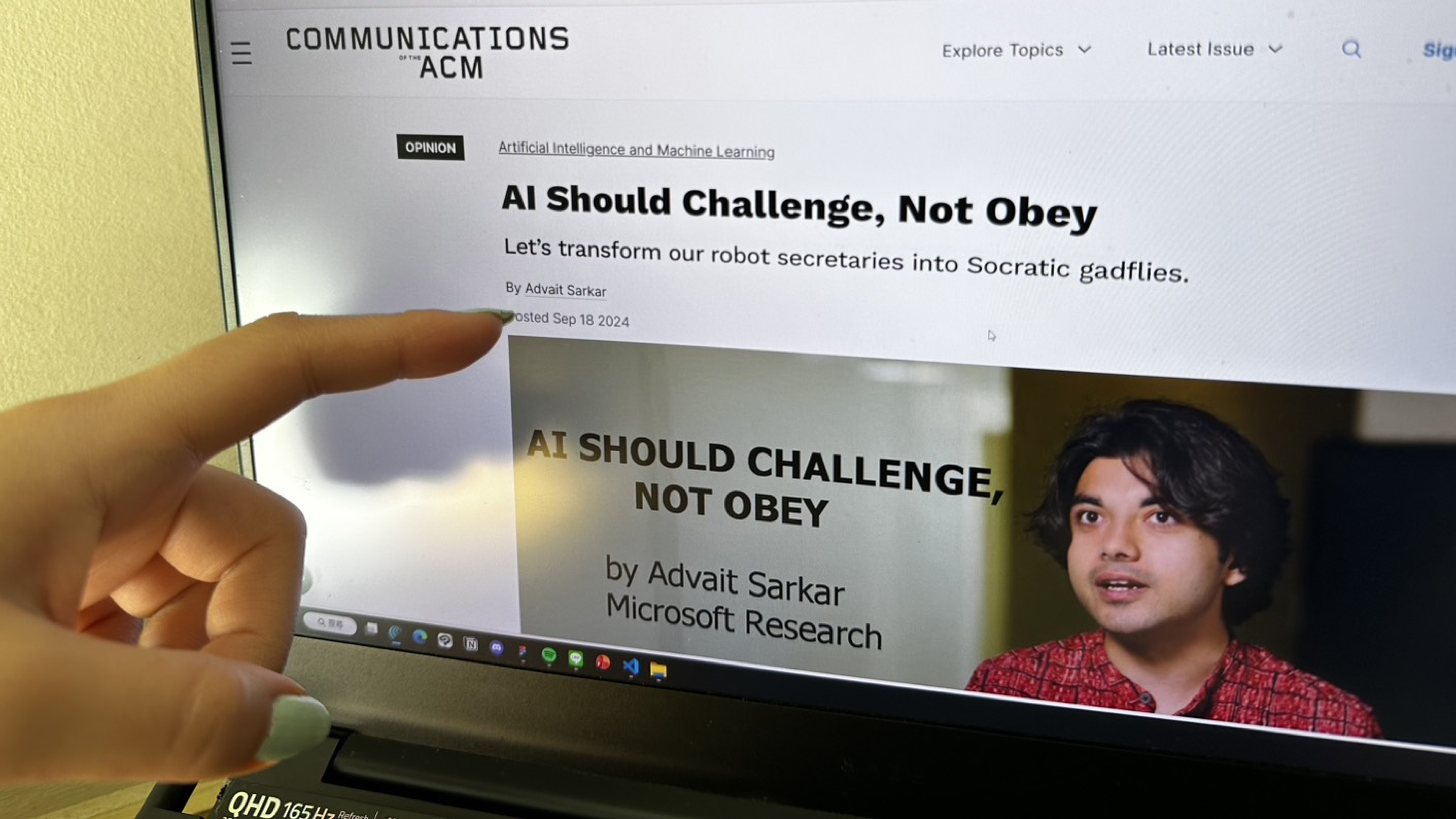
People didn’t need another AI to give them answers. They needed a reason to stop and look again at the answer they already had.
03 / Focus
From seven feature ideas to four.
Adding more features made the product harder to explain, not easier. We went back to the research and to what we could realistically build, and cut the list down.
Explore. User research and a review of 13 competing products.
Prioritise. Seven candidate features, scored on impact and feasibility.
Focus. Four core features for the MVP: prompt suggestions, sources, counter-arguments and the Think-Board.
04 / Features
A reason to stop and look again.
Suggested follow-up questions
Before you accept an answer, CritiqueAI suggests a few questions to ask next. Click one to copy it.
The sources behind each claim
The panel lists the sources behind a claim and what to look out for in each one. Anything you save goes to your Think-Board.
Views that push back
It also shows arguments against the claim, each with a source, so you can compare them before deciding.
A place to keep your notes
Saved sources and your own reflections are collected on boards you can come back to, across topics. Anything you saved on this page shows up here.
05 / Questions
My role
I was the Product / Research Lead in a team of six, on a 2026 project at Goldsmiths, University of London. I led product strategy and user research, and planned and drove the work from the early focus groups and competitor review through to feature prioritisation, experience design and usability testing. My job in the team was to turn what we learned in research into concrete product decisions, so that every feature answered a real problem people had.
How research shaped the product
In the focus groups, we asked people how they use generative AI to learn and look things up. Hardly anyone asked for better answers. What came up more often was that once an answer reads smoothly enough, it is hard to convince yourself to spend time checking it. What people lacked was a moment that made them stop and think again. That finding moved us away from giving people more information, towards a tool that fits into the way they already read and prompts them to question at the right moment.
Why only four features
We reviewed 13 similar products, drew up seven candidate features and scored each one on impact and feasibility. Along the way we found that the more features we added, the harder the product was to understand, and the harder it was to say in one sentence what it was for. We kept four: prompt suggestions, sources, counter-arguments and the Think-Board. The first three answer “what should I ask next?”, “what is this based on?” and “is there another view?”, and the Think-Board lets that thinking build up over time. Those four were enough to explain what the product is for.
What I took away
A good AI product shouldn’t start from what AI can do next. It should start from what people need. The biggest thing I learned was how to choose between many possible directions: every extra feature has to name the problem it solves. Research, prioritisation and testing turned an open-ended AI brief into a product with a clear purpose, one we could describe in a single sentence.
Credits
- Project
- CritiqueAI
- Year
- 2026
- Role
- Product / Research Lead
- Team
- Six people
- Context
- Goldsmiths, University of London
- Recognition
- UX Design Awards 2026 Nominee